Online Blackjack: Rules, Strategy and Live Dealer Play
Last updated: February 2026 · Reviewed by the Casino and Betting India editorial desk

Last updated: February 2026 · Reviewed by the Casino and Betting India editorial desk
"Before you place a single rupee on a table, understand the rules, the house edge, and the payout rules. A solid strategy reduces player errors, but online blackjack should always be treated as paid entertainment, never as a source of income or a shortcut to profit." (Nisha Rao, Content Editor at Casino and Betting India)
Online blackjack is one of the most popular card games in the casino world. Simple rules, fast decisions, and a house edge you can actually measure. Whether you are testing a blackjack demo in free-play mode or comparing blackjack real money tables, three things matter first: how hands are counted, how the dealer must act, and how payments work for players in India.
That last part is the one most guides skip. So we will not.
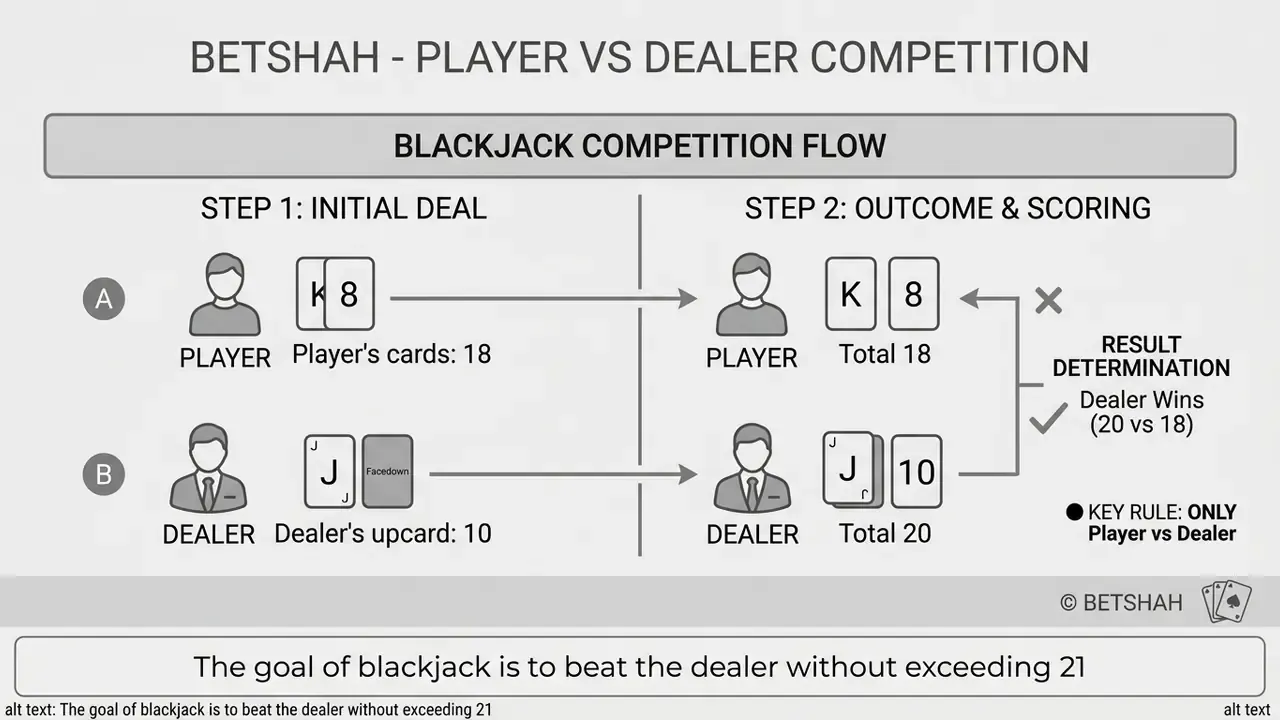
Blackjack is a casino card game where each player competes individually against the dealer to build a hand total closer to 21 than the dealer's, without going over. In any standard blackjack game you are not playing against the person in the next seat. Your job is narrower: read your own hand, judge the dealer blackjack potential from the single visible card, and pick the decision with the best expected value.
If you want the wider industry context behind these products before you study the rules, our overview of the iGaming market explains how operators, game studios and regulators interact.
Blackjack is also one of the fastest-growing verticals inside regulated online casino markets. That growth is exactly why table-game rule transparency now gets regulator-level attention.
"In 2024, New Jersey internet gaming revenue exceeded 2.3 billion dollars, up 24.1% compared with 2023." New Jersey Casino Control Commission Annual Report (2024). https://www.nj.gov/casinos/
The roots of blackjack go back to 18th-century French card games, specifically Vingt-et-Un, which translates directly as "Twenty-One". Card-game historian David Parlett dates the French version to around 1760, when it circulated as a respectable salon game. As it spread to North American gambling houses in the late 19th and early 20th centuries, venues added promotional payouts to pull players in. One famous bonus paid 10-to-1 when the opening two cards contained the Ace of Spades plus a black Jack (Spades or Clubs). Casinos dropped that bonus long ago. The name stayed.
Today, whether you play classic casino blackjack or sit at a blackjack live casino table, the target score is still 21.
The game travelled well for structural reasons, not sentimental ones. Rounds resolve in under a minute, the objective is instantly understandable, and house rules (deck count, soft 17 handling, doubling limits) can be tuned without breaking the core mechanic.

In blackjack, card values are standardised across almost every variation. Numbered cards keep their face value, picture cards count as 10, and the ace flexes between 1 and 11.
As documented in official gaming standards (Maryland State Lottery and Gaming Control Agency, 2024), this flexible scoring lets players draw on soft hands with zero risk of busting on the next card. Loto-Québec's published blackjack rules describe the same logic: the Ace is automatically counted at whichever value gives the best total without busting.
Card values and scoring in blackjack
| Cards / Combination | Category | Point value | How it is counted |
|---|---|---|---|
| 2 to 10 | Numbered cards | Face value (2 to 10) | Added at their direct numeric value. |
| J, Q, K | Picture cards (card face) | 10 points | All picture cards share the same value of 10 points. |
| A (Ace) | Flexible card (ace) | 1 or 11 points | Counted as 11 while the total stays under 22, otherwise as 1. |
| Soft hand | Combination with Ace = 11 | Current total | Lets you draw one more card safely (hit). |
| Hard hand | No Ace, or Ace = 1 | Fixed total | Above 11 points, drawing carries a real bust risk. |
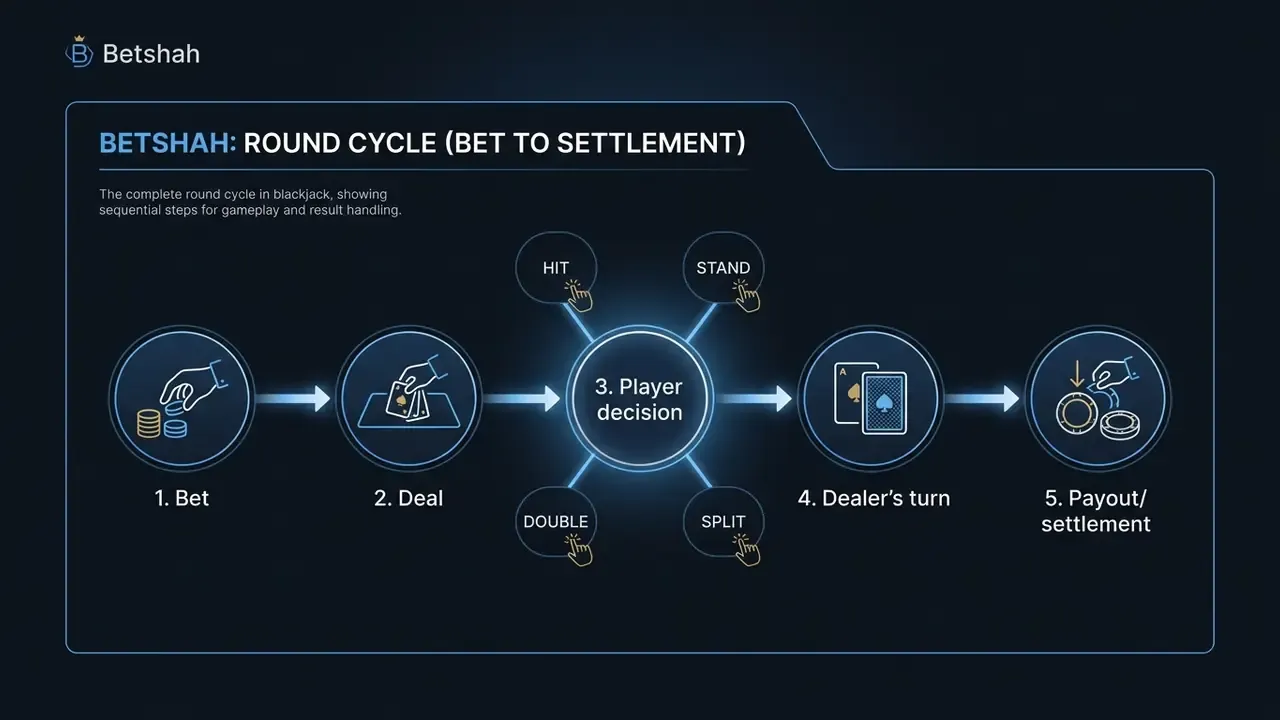
A single round of online or live blackjack follows a strict sequence, from the opening wager to final settlement. Learning blackjack rules properly protects you from two ordinary problems: accidental misclicks, and misreading what the table actually allows.
A round begins when a player places the opening bet in the marked betting spot. Once bets lock, the dealer issues two cards to each player position and two cards to the dealer box: one face up (the visible card face) and one face down, known as the hole card.
If your opening deal pairs an Ace with any 10-value card, that is a natural blackjack, paid at 3:2 on the original wager. The exception is a dealer natural at the same time, which produces a tie (a "push") and returns your stake.
Insurance, where it is offered, is a separate wager placed after the initial deal and before any further cards reach the players. Connecticut's live-dealer technical specifications add a detail worth remembering: if the physically displayed rule set and the on-screen rule set disagree, the rule more favourable to the player must prevail. Handy to know if you ever spot conflicting information at a streamed table.
After the opening hand lands, you choose one of five standard actions, based on your total and the dealer's visible card:
Beyond the five core actions, individual tables and variants layer on optional rules. Each one nudges the house edge, so read the info panel before you sit down. It takes ten seconds and can be worth more than any bonus.
Special and local rules across blackjack variations
| Rule / Term | How it works | Effect on house edge |
|---|---|---|
| Bet Behind | Lets you back another seated player's hand, useful when a live table is full. On some Evolution tables the number of such bets is unlimited. | Depends entirely on the accuracy of that player's decisions. |
| 10 Card Charlie | Automatic player win on reaching 10 cards without busting. | Reduces the house edge by roughly 0.01%. |
| Early / Late Surrender | Fold the hand and reclaim 50% of the stake. Early comes before the dealer checks for blackjack, late comes after. | Early surrender cuts the edge by about 0.63%, late by about 0.08%. |
| Double Any 2 | Doubling permitted on any two starting cards. | The most player-friendly doubling rule available. |
| Double 9 to 11 Only | Doubling allowed only on totals of 9, 10 or 11. | Increases the house edge by roughly 0.09%. |
| Hit Split Aces | After splitting aces, only one extra card per hand, the standard at most tables. | A restriction in the casino's favour. Where drawing is allowed, the edge falls. |
| Resplit / Resplit Aces | Split again when another matching pair appears, aces included. | Reduces the house edge by roughly 0.06%. |
| Dealer Hits Soft 17 | The dealer must draw on soft 17 (A+6). | Increases the house edge by roughly 0.2%. |
"Blackjack comes in a lot of different flavors. Before you try any variation, get comfortable with the basic game and basic strategy. If you're going to try a variation, research it first, find out the house edge and proper strategies." (Andrew Brisman, author of the American Mensa Guide to Casino Gambling)
If you are new to the game, play the simplest rule set first. Add special features (surrender, resplits, multipliers, side bets) only once the base decisions feel automatic.
Once every player at the table has finished, the dealer flips the hole card and completes the dealer blackjack hand under fixed, non-negotiable rules. The dealer has no choices at all, which is a point beginners often miss.
In standard rule sets (Washington State Gambling Commission, 2024), the dealer must draw on totals of 16 or lower and must stand on any hard total of 17 or higher. Some variants require a hit on soft 17 (Ace + 6), which slightly widens the casino's advantage. Colorado's Division of Gaming rules explicitly let operators pick either configuration, so the panel on the table remains the only reliable source.
"The dealer must draw on totals of 16 and below and stand on any hard total of 17 or above. This standard is reproduced in modern MDP models of blackjack as well." Sinitsin et al., arXiv (2026); Bordeu and Castro, arXiv (2025). https://arxiv.org/
The round then resolves in one of three ways:
A structured blackjack strategy removes avoidable mistakes and squeezes the mathematical house edge to its practical minimum. No strategy erases the casino advantage. Still, playing decisions grounded in probability rather than instinct is the difference between a controlled session and guesswork.
The foundation of strategy blackjack is the basic strategy matrix: the mathematically optimal decision for every combination of player hand and dealer upcard.
Research published by Sinitsin et al. (2026) shows that perfect basic strategy in multi-deck games lowers the house edge to roughly 0.5%, which translates to a theoretical win rate near 42.4% on individual hands, pushes excluded. The number comes from an eight-deck simulation benchmark with a reinforcement-learning agent evaluated across ten independent runs.
"Applying perfect basic strategy reduces the house edge to approximately 0.5%, and the player wins about 42.4% of hands, excluding pushes, in an eight-deck simulation." Sinitsin et al., "Learning to Play Blackjack: A Curriculum Learning Perspective", arXiv (2026). https://arxiv.org/
Older strategy work reaches the same place from a different direction. Edward O. Thorp's Beat the Dealer (1962) first published the expected-value tables that modern charts still reproduce, and rule-dependent edge calculations are maintained publicly in the Wizard of Odds blackjack section (2023). https://wizardofodds.com/games/blackjack/
Basic strategy cheat sheet
| Player hand type | Dealer card: 2 to 6 (weak) | Dealer card: 7 to A (strong) |
|---|---|---|
| Hard 8 or lower | Hit | Hit |
| Hard 9 to 11 | Double, or hit if not allowed | Hit (double 11 against 7 to 10) |
| Hard 12 to 16 | Stand | Hit |
| Hard 17 and above | Stand | Stand |
| Soft 13 to 17 | Double where permitted, else hit | Hit |
| Soft 19 and above | Stand | Stand |
| Pairs A,A and 8,8 | Split | Split |
| Pairs 10,10 and 5,5 | Never split | Never split |
Alert box: responsible play and the math Basic strategy minimises human error. It does not guarantee a win or create a risk-free scenario. The casino keeps a structural house edge on every table, in every format. Set strict bankroll limits in Indian Rupees before you play anywhere. The Lower-Risk Gambling Guidelines (Canadian Centre on Substance Use and Addiction, 2021) recommend spending no more than 1% of pre-tax household income per month, gambling no more than four days per month, and sticking to no more than two game types.
Alongside the core decisions, live tables push optional wagers that settle instantly from the opening cards. They are entertaining. They are also structurally expensive.
The mathematical verdict is blunt. Side bets carry a house edge of up to about 13%, against roughly 0.5% on the main game played with basic strategy. Treat them as an entertainment cost with a small fixed budget, never as part of a strategy. Experienced players rarely make them a routine feature of every hand.
In classic RNG blackjack the virtual shoe is reshuffled after every hand, so any running count resets to zero before it can carry information. In live-dealer studios a cut card divides a six or eight-deck shoe, and cards head to the discard tray long before the shoe runs out. Penetration rarely exceeds about 50%.
That combination neutralises the advantage of counting systems such as Hi-Lo, and many live tables add continuous shuffling machines on top. Practising a counting drill will sharpen your arithmetic. It will not create an edge online.
Managing your betting budget matters as much as knowing when to hit or stand. Flawless hand decisions still burn a bankroll fast if the stake size is wrong for the balance.
"Optimised betting strategies based on exact deck composition outperform the Hi-Lo system only marginally, and they do not remove the house edge." Bordeu and Castro, "Optimal Blackjack Betting Strategies Through Dynamic Programming and Expected Utility Theory", arXiv (2025). https://arxiv.org/
When testing mobile usability and payment methods for Indian players, I set a fixed testing budget of ₹5,000 and flat-bet ₹100 per hand. Across 50 rounds in a mobile browser, that controlled approach kept emotion out of the decisions and let me check app performance, live-video latency and balance-reporting accuracy without distraction.
[💬 QUOTE: "No betting system can overcome the underlying mathematical house edge over time. Managing your stake size is about controlling variance and protecting your entertainment budget, not manufacturing guaranteed profit." (Nisha Rao)]
Purpose: E-E-A-T reinforcement of the author's position on betting systems.
Semantics: blockquote + cite.
Newer players tend to add losses to a session in predictable ways, either by drifting from basic strategy or by walking into familiar psychological traps:
"A randomised trial found that personalised normative feedback improves gambling awareness, with an effect size of d = 0.32." Randomised Controlled Trial on Positive Play / Personalised Normative Feedback, PubMed Central (2023 to 2024). https://www.ncbi.nlm.nih.gov/pmc/
Modern blackjack online platforms group tables into formats built for different devices, connection speeds and temperaments. Pick the format before you pick the table.
Classic RNG online blackjack is software-based: outcomes come from certified mathematical algorithms rather than physical cards. Regulatory standards (UK Gambling Commission, RTS 7, 2026) require RNG output to be acceptably random, meaning uniform, unpredictable, non-repeating and seeded unpredictably.
"A DQN agent trained with curriculum learning reached a 47.41% win rate in an eight-deck blackjack simulation, cutting the bust rate from 32.9% to 28.0%." Sinitsin et al., arXiv (2026). https://arxiv.org/
That benchmark is a useful reality check. Even a purpose-built algorithm, tuned in a controlled eight-deck simulation, lands below the 50% line once pushes are counted.
The blackjack live dealer format streams a human croupier working a physical table from a dedicated studio. Cameras capture every draw, and digital overlays let remote players place bets electronically in real time.

Operators build specialised versions of standard blackjack games around unique rules or multipliers:
Comparison of online blackjack formats
| Parameter | Classic RNG blackjack | Blackjack live dealer | Special variants (Lightning / Switch) |
|---|---|---|---|
| Who runs the round | Random number generator | A real live dealer | Live dealer plus RNG multipliers |
| Speed of play | Very high, set by the player | Moderate, 45 to 60 hands per hour | Medium, multiplier phase included |
| Demo mode | Widely available | Usually absent, watching only | Rarely available |
| Minimum bet | Low, from ₹10 to ₹50 | Medium to high, from ₹100 to ₹500 | Medium, plus the feature fee |
| Side bets | Optional, limited set | Perfect Pairs, 21+3, Bet Behind | Extended set plus multipliers |
Understanding the step from free practice to cash wagering prevents both unnecessary risk and avoidable financial friction. Rush it, and you learn the interface with your own money.
A blackjack demo hands you virtual credits, letting you interact with the mechanics at zero financial risk.
One caveat is worth knowing. Research on simulated gambling reports that free-play sessions can inflate both perceived control and win expectations, because demo modes strip out loss salience entirely. Use the demo to rehearse decisions, not to calibrate expectations about outcomes.
Before you move to blackjack real money tables, verify a short list of technical and structural details:
Legal and trust disclaimer: Real-money online casino participation depends on local regulations, minimum legal age limits (18+ or 21+ depending on the jurisdiction) and account verification through KYC. Everything on this page is educational and informational. It is not legal or financial advice.
General notice: This information is general in nature and does not replace professional advice. Online gambling is governed by the law of your own jurisdiction. Confirm that participation is lawful for you before registering anywhere.
Picking a reliable blackjack casino comes down to safety infrastructure, payout behaviour and honest bonus terms. Marketing claims are the least useful signal on the page.
"A GameSense study in Massachusetts casinos found that adviser visibility and message clarity are key factors in player engagement with safer-play tools." Massachusetts Gaming Commission, "Players' Awareness of and Engagement with GameSense", FY2024. https://massgaming.com/
Welcome packages look generous on the banner. Their real value depends almost entirely on wagering requirements:
The table below summarises typical cashier behaviour on Indian accounts. Ranges are indicative only. Exact limits, fees and timings are set by each operator and payment provider, so confirm them in the cashier before you deposit.
Payment methods for online blackjack in India (typical parameters)
| Method | Deposit speed | Withdrawal speed | Typical limits and fees |
|---|---|---|---|
| UPI | Instant | 1 to 4 hours after KYC | Low minimum, from ₹100 to ₹500. Fees usually none. |
| NetBanking | Instant to a few minutes | 1 to 3 business days | Medium limits, depends on the bank and its working hours. |
| IMPS / bank transfer | Minutes to hours | 1 to 2 business days | Higher limits, verified account required. |
| AstroPay and e-wallets | Instant | Up to 24 hours | Currency conversion and a service fee are possible. |
| Crypto (BTC/USDT) | 10 to 60 minutes on-chain | 1 to 4 hours | Network fee applies, rates are volatile, limits high. |
Completing KYC before your first withdrawal request, rather than after it, is the single biggest factor in payout speed. Everything else is secondary.
While testing an India-facing online casino platform, I checked a live dealer table to see how withdrawal limits and bonus terms behaved under real conditions. I deposited ₹2,500 via UPI, played basic strategy across 20 rounds of classic RNG blackjack, requested a withdrawal of ₹2,800, and confirmed the transaction processed within 4 hours after standard KYC verification. Documents had been submitted once, at registration, which removed any queue at the cashout stage. One test is not proof of a pattern, of course, but the sequence is worth copying.
[❓ QUIZ: 4 questions checking readiness to choose a casino. Logic: Licence -> UPI payments -> 3:2 table -> Wagering limits.]
Purpose: Interactive self-check for the reader before registering.
Semantics: section role="form"; aria-labels; questions and text answer options present in the DOM.
Responsible gambling notice: Set a spending limit before you play, wager only money you can afford to lose, and stop when the limit is reached (Victorian Responsible Gambling Foundation, 2024). If gambling stops feeling like entertainment, use the platform's self-exclusion tools and contact a professional support service. 18+ or 21+ only, depending on your jurisdiction.