Online Baccarat: Rules, Bets, House Edge and Live Dealer Play

Last updated: editorial review completed for the 2026 season. Rules, payouts and house edge figures verified against published regulatory rulebooks (Nevada Gaming Control Board, California Bureau of Gambling Control, Massachusetts Gaming Commission) and independent probability analyses.
«Before you place a single bet on a baccarat table, check the withdrawal rules, wagering terms and the exact game variant. Understanding house edge and third-card mechanics matters far more than promotional hype.» — Nisha Rao, Casino and Betting India (editorial reviewer, table games and live casino compliance)

Baccarat is simple to play and unusually clean mathematically. Two hands, three bets, no decisions to agonise over. Originating in European gaming halls, the modern baccarat game, played almost everywhere as Punto Banco, combines fast round resolution, fixed automated drawing rules and some of the lowest house edge figures in online gambling. For readers researching baccarat online from India, three things decide the actual experience: how card values work, how payout and bonus terms operate, and how payment friction or verification affects withdrawals.

Read that last part twice. Most complaints we see are not about the cards.

This editorial guide gives a compliance-first overview of baccarat rules, betting options, live dealer infrastructure, strategy mechanics, payment and KYC realities in India, plus safety checks for English-speaking readers. If you are still comparing brands, our overview of iGaming platforms for online play explains how licensing, payout speed and game libraries differ.

Baccarat is simple to play and

Key Takeaways

  • Three core bets only: Player (pays 1:1, house edge 1.24%), Banker (pays 0.95:1 after 5% commission, house edge 1.06%), Tie (pays 8:1, house edge 14.36%).
  • Banker is mathematically the best standard bet, even after commission. Expected loss is roughly 1.06 units per 100 units wagered.
  • You never make card decisions. Third-card draws are fully automated by a fixed regulatory matrix. "Player" and "Banker" are labels for two hands, not for you and the casino.
  • "No Commission" tables are not cheaper. The Super 6 rule (Banker 6 pays 0.5:1) lifts the Banker house edge from 1.06% to 1.46%, about 17% worse for the player.
  • Side bets are expensive. Pairs (~10.36%), Small (5.27%), Big (4.35%), Dragon Bonus (2.65% Player / 9.37% Banker), Dragon Tiger Tie (up to 32.77%).
  • Lightning-style multiplier tables add a mandatory 20% fee per wager in exchange for random 2x to 8x card multipliers (up to 512x on main bets, 262,144x on Tie).
  • No progression system beats the edge. Martingale, Fibonacci, Paroli and d'Alembert change variance, not expected value.
  • India-specific friction matters: complete KYC (PAN, address proof) before your first bet, confirm UPI/IMPS/NetBanking eligibility, and calculate bonus wagering at the table-game contribution rate, not the headline rate.
Key Takeaways. - Three core bets

What is Baccarat and What is the Main Objective?

Baccarat is a card-comparing game where two designated hands, the Player and the Banker, are dealt from a shared shoe to see which finishes closest to nine. The objective of the baccarat game is not to build your own hand. It is to predict correctly which of three outcomes lands: Player win, Banker win, or Tie.

Unlike blackjack, you receive no cards of your own and make no in-round decisions such as hitting or standing. The dealer performs every action according to strict pre-set rules. The mathematical goal stays simple: pick the hand that finishes closest to a modulo-10 total of 9. A live baccarat table normally runs from eight standard 52-card decks, and every wager settles only after all cards for that round are dealt.

What is Baccarat and What is

Player, Banker, and Tie: Core Betting Options

The three foundational betting options are the Player bet, the Banker bet and the Tie bet.

  • Player bet:wagers that the Player hand finishes closer to 9 than the Banker hand. A winning Player bet pays 1:1 (even money) with no commission.
  • Banker bet:wagers that the Banker hand finishes closer to 9. Under standard rules, winning Banker bets pay 1:1 minus a 5% house commission, so the effective payout is 0.95:1.
  • Tie bet:wagers that both hands finish with identical point totals. A winning Tie bet usually pays 8:1, occasionally 9:1 in select rule sets. When a round ties, main bets on Player and Banker are returned as a push.
Player, Banker, and Tie Core Betting

«Banker wins ~45.86% of hands, Player ~44.62%, and ties occur ~9.52% of the time in a standard eight-deck shoe.» — BaccaratProTips Payout Chart (2026). https://baccaratprotips.com

One point that trips up almost every beginner in India: "Player" and "Banker" are just names for the two dealt hands, not references to you or to the online casino operator. You may back either side in any round, and switch sides freely from hand to hand. Nobody at the table is "your" side.

Card Values and Round Winner Determination

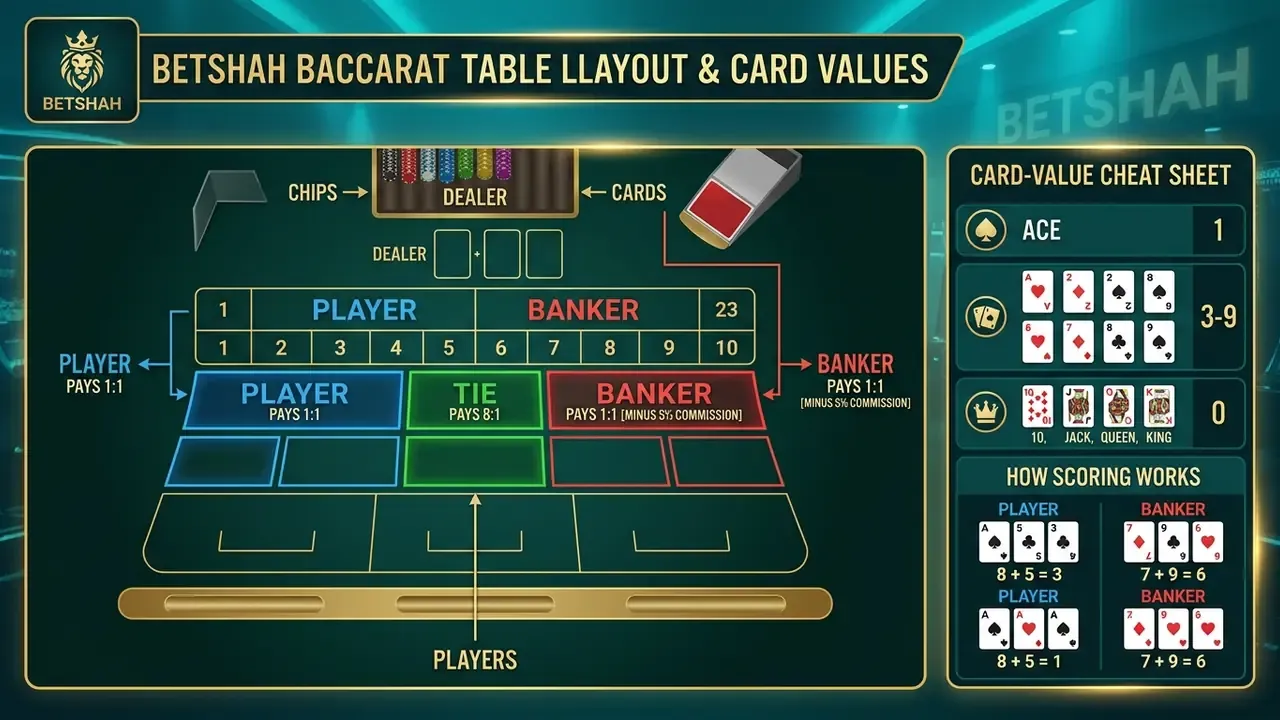
The value of a baccarat hand is the sum of its card values with the tens digit dropped, so the final total always sits between 0 and 9.

Card point values are fixed:

  • Aces:1 point.
  • 2 through 9:face value, so a 7 is worth 7 points.
  • 10, Jack, Queen, King:0 points.
Card Values and Round Winner Determination

When a raw sum reaches 10 or more, only the rightmost digit counts. An 8 and a 7 raw-total 15, which gives a baccarat value of 5. A King plus a 10 equals 0 points, the hand traditionally called baccarat. A total of 20 becomes 0; 12 becomes 2. The hand nearest to 9 takes the round.

Baccarat table layout and card point values

Baccarat Rules: Card Dealing and the Third-Card Rule

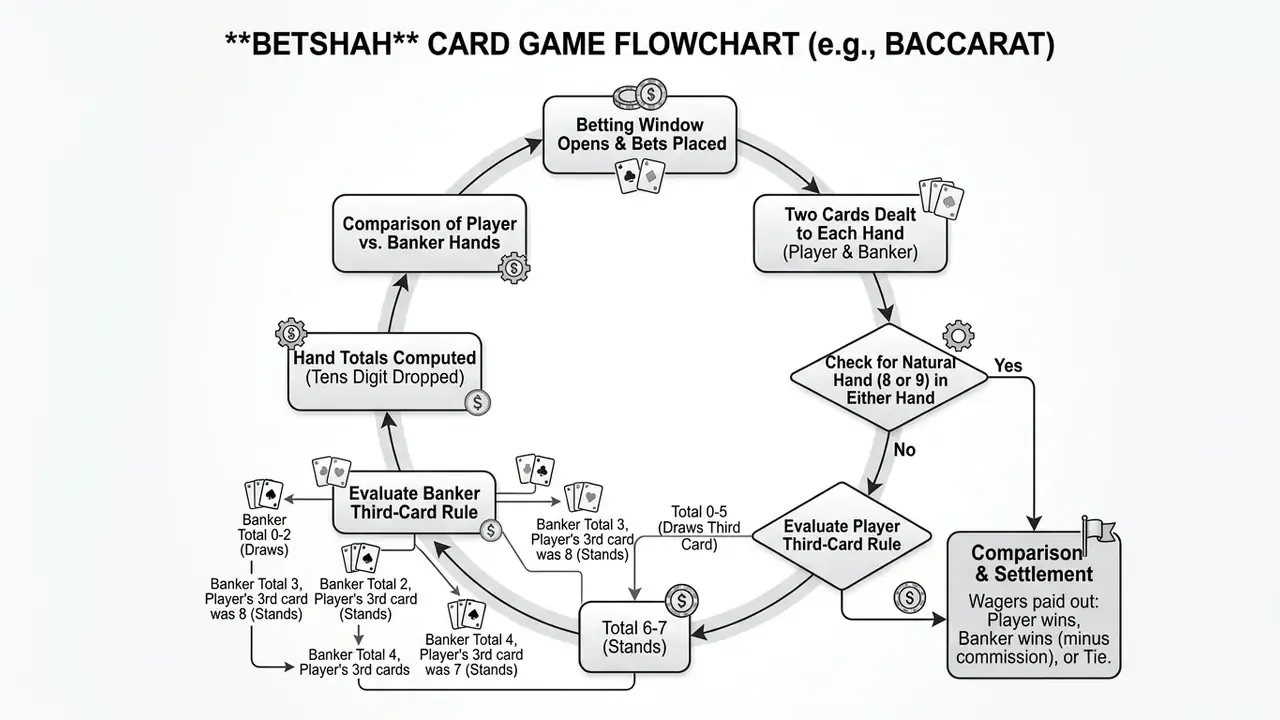
Baccarat rules open every round with two cards dealt face-up to both the Player and Banker positions. If neither hand shows an immediate "natural" of 8 or 9, the game moves automatically to the third-card drawing rules.

Every dealing decision follows a rigid regulatory matrix. Neither you nor the dealer exercises personal choice during distribution, a point confirmed in published rulebooks from several jurisdictions, where the Player hand always acts first and the Banker hand responds.

Initial Two Cards and Natural Wins

A "natural" occurs when the Player or Banker hand totals 8 or 9 on the first two cards. The round then ends immediately, with no further draws. A natural overrides every other drawing rule.

  • Natural 9:the strongest starting hand. It beats any lower total.
  • Natural 8:beats totals of 0 through 7. Against a Natural 9, the 9 wins.
  • Tie natural:if both hands show initial 8s or initial 9s, main wagers push and Tie bets win.
Initial Two Cards and Natural Wins

Frequency of naturals, verified against regulator rules of play rather than secondary sources:

«With a standard eight-deck shoe, a natural win occurs in roughly 15.9% of all dealt hands under the combinatorial structure of the published rules of play.» — Nevada Gaming Control Board, Live Baccarat Rules of Play. https://www.gaming.nv.gov/siteassets/content/divisions/enforcement/rules-of-play/Live_Baccarat_Rules_of_Play.pdf

When the Player Hand Draws a Third Card

The Player hand always acts first when third-card criteria are evaluated. With no natural on the table, it draws or stands purely on its two-card total:

  • 0 to 5 points:the Player hand draws a third card automatically.
  • 6 or 7 points:the Player hand stands automatically.
  • 8 or 9 points:natural win, no cards drawn.
When the Player Hand Draws a

Once the Player hand stands or takes its third card, that total is locked and the game turns to the Banker hand.

How a single baccarat round resolves

Banker Third-Card Rules Matrix

The Banker hand's action depends on its own two-card total and, when the Player drew, on the exact value of the Player's third card.

If the Player stood on 6 or 7, the Banker draws on 0 to 5 and stands on 6 to 7. If the Player drew, the Banker follows this official matrix:

Banker two-card totalBanker action
0, 1, 2Draws regardless of the Player's third card
3Draws unless the Player's third card was an 8
4Draws if the Player's third card was 2, 3, 4, 5, 6 or 7
5Draws if the Player's third card was 4, 5, 6 or 7
6Draws only if the Player's third card was 6 or 7
7Always stands
8, 9Natural, round already over

This structure, codified in frameworks such as the Nevada Gaming Control Board Live Baccarat Rules, tilts things slightly toward the Banker position by letting it act last. That informational advantage is exactly why the Banker bet carries a 5% commission.

«Commission-Free Baccarat rules reproduce the same third-card decision matrix, confirming a uniform punto banco standard across jurisdictions.» — California Bureau of Gambling Control, Commission-Free Baccarat Rules. https://oag.ca.gov/sites/all/files/agweb/pdfs/gambling/BGC_CommFree_Baccarat.pdf

Baccarat Betting Options: Main Bets and Side Bets

Choosing a baccarat bet means weighing three things at once: payout size, probability, and the house edge attached to that position. Main bets give long-term statistical consistency. Optional side bets swap low probability for larger one-off payouts.

Main Bets: Player, Banker, and Tie Probabilities

The mathematics of standard eight-deck main bets is fixed across licensed online casinos:

BetPayoutWin probabilityExcluding tiesHouse edgeRTP
Banker0.95:1 (1:1 minus 5%)~45.86%~50.68%1.06%98.94%
Player1:1~44.62%~49.32%1.24%98.76%
Tie8:1 (9:1 in select venues)~9.52%14.36% (4.84% at 9:1)85.64%

«On a Banker bet the expected loss is about 1.06 units per 100 units staked, the lowest of the three main bets.» — BaccaratProTips Payout Chart (2026). https://baccaratprotips.com

Because the Banker bet keeps a 1.06% house edge even after the commission is deducted, it stays the strongest standard wager on a baccarat table. In rupees: cycle 10,000 INR of turnover through Banker bets and the expected theoretical cost is about 106 INR, against 124 INR on Player and roughly 1,436 INR on Tie. Same table, same cards, very different arithmetic.

Baccarat Side Bets: Pair, Dragon Bonus, and Big/Small

Side bets let you wager on specific card combinations independently of the main outcome. They look attractive on the felt. They cost more:

  • Player / Banker Pair:wins if the first two cards of that hand form a pair, such as 7-7. Standard payout is 11:1, with a house edge around 10.36% (RTP 89.64% in published rule sets).
  • Perfect Pair:wins if the two initial cards on a chosen side match in rank and suit. Payouts run from 25:1 for a single perfect pair to 200:1 for two in the same round, with published RTP near 91.95% on the 25:1 version.
  • Big / Small:a wager on how many cards the round uses. Small wins on 4 cards; Big wins on 5 or 6.
Baccarat Side Bets Pair, Dragon Bonus

«With six decks, the Small bet (four cards, paying 1.5:1) carries a 5.27% house edge, while the Big bet (five to six cards, paying 0.54:1) carries 4.35%.» — Wizard of Odds, Baccarat Side Bets. https://wizardofodds.com/games/baccarat/side-bets/

  • Dragon Bonus: pays when a hand wins by a margin of 4 to 9 points, or with a natural win.

«The Dragon Bonus on the Player side runs a 2.65% house edge, while the Banker-side version reaches 9.37% with eight decks.» — Wizard of Odds, Baccarat Side Bets Analysis. https://wizardofodds.com/games/baccarat/side-bets/

  • Tiger family (Nevada-approved paytables): some regulated live tables add Tiger, Small Tiger, Big Tiger and Tiger Pair wagers paying from 4:1 up to 100:1. High headline odds again mean low hit frequency, so treat them as entertainment spend, not value bets.

Editorial observation: in our hands-on review of live baccarat lobbies marketed to Indian users, side-bet buttons usually sit right next to the main betting spots, and they are often the first thing a new user taps. We have run no controlled study, so we make no quantified behavioural claim. What is verifiable is the arithmetic: every unit moved from a 1.06% Banker bet into a 10.36% Pair bet multiplies the theoretical cost of that unit by roughly ten, which shortens how many rounds a fixed budget survives.

Situation: An Indian user searching for baccarat options deposited INR 5,000 and repeatedly placed INR 500 wagers on the Tie bet and Pair side bets, depleting the balance within 12 rounds.
Action: The player switched to a structured practice model, testing standard Banker wagers in demo mode while studying house edge calculations.
Result: The player reduced expected statistical drag from 14.36% down to 1.06% per round, maintaining budget control across extended session times.
- Tiger family Nevada-approved paytables some

No Commission Baccarat and Super 6 Mechanics

No Commission Baccarat drops the 5% fee on winning Banker bets and pays 1:1 on most Banker wins. To recover that advantage, operators add the Super 6 rule: when the Banker hand wins with exactly 6 points, the payout falls to 1:2, that is 0.5:1.

One adjustment, and the Banker house edge climbs from 1.06% to 1.46%.

«Moving from commission baccarat to a No Commission format increases the Banker-bet house advantage by about 17%, from 1.06% to 1.46%.» — Tangam Systems, No Commission Baccarat analysis. https://tangamsystems.com

So despite the "fee-free play" framing, No Commission Baccarat is mathematically worse for you than classic commission baccarat. Worth adding: the optional Super 6 side bet, a wager that Banker wins specifically with 6, is paid differently by jurisdiction. Some approved rule sets pay 15:1; others pay 12:1 for a two-card six and 20:1 for a three-card six. Read the in-game paytable before you stake anything.

E-E-A-T rule verification: checked against the Bureau of Gambling Control (California OAG) Commission-Free Baccarat Rules, Nevada Gaming Control Board Approved Paytables and the Massachusetts Gaming Commission Baccarat Rules. Standard commission baccarat retains a 1.06% Banker house edge, while Super 6 No Commission formats move it to 1.46%. Always confirm table rules before placing real money stakes.

So despite the fee-free play framing

Online Baccarat Variants: Demo, Speed, and Multipliers

Online casinos offer several baccarat formats built around different session speeds, devices and goals. Winning conditions never change. What changes is pace, table size, payout modifiers and whether a human dealer is involved.

Baccarat Demo for Learning the Rules

Baccarat demo is a free-play, RNG-driven software version running on virtual practice credits. It reproduces the same dealing logic, the same third-card draw rules and the same payout calculations, with no real money exposed.

Demo mode lets beginners in India test table interfaces, practise tracking hand values and watch how rarely side bets actually land, all before funding an account through local rails such as UPI or NetBanking.

«Interactive gaming revenue continues to expand, with table games forming a meaningful share of total iGaming win.» — Sterner et al., Pennsylvania Interactive Gaming Report (2024). https://www.ddap.pa.gov

That growth is precisely why practising free first matters. The format keeps getting faster, busier and more heavily promoted, and a demo table is the cheapest place to make your beginner mistakes.

Classic, Speed and No Commission Baccarat

  • Classic Live Baccarat:standard pace of roughly 45 to 60 seconds per round, physical card draws by a studio dealer, standard 5% Banker commission. Suits players who want time to think.
  • Speed Baccarat:rounds resolve in about 27 seconds because cards are dealt face-up immediately. Betting windows compress to around 12 seconds, which also means hourly turnover, and therefore theoretical loss, rises sharply at the very same stake.
  • No Commission Baccarat:swaps the 5% commission for half-pay on Banker 6, which speeds up collection at the price of a higher house edge (1.46%).
Classic, Speed and No Commission Baccarat

If you are weighing these paces against each other, our guide to online casinos with live dealer tables sets out how lobby structure, table limits and stream quality differ between operators serving Indian players.

Multiplier Baccarat: Lightning and Quantum Variants

Modern live casinos also run high-variance multiplier variants, most visibly Evolution's Lightning Baccarat and similar "Quantum" style tables. Each round, before dealing, 1 to 5 "Lightning Cards" are generated at random and each gets a payout multiplier between 2x and 8x.

When a winning hand contains one or more matching Lightning Cards, the standard payout is multiplied. Matching several across one winning hand compounds the effect up to a cap of 512x on main bets and as high as 262,144x on Tie bets. Funding all this is a mandatory 20% "Lightning Fee" on every wager placed, so a 100 INR bet debits 120 INR in total.

Look at it as a fee and the trade becomes obvious: you pay a fixed 20% premium every round for a chance at rare multiplied wins. The nominal house edge on main bets stays near 1.06%, yet variance is far higher and a balance drains faster during dry spells. Fun format, unforgiving pace.

Multiplier Baccarat Lightning and Quantum Variants

Mini Baccarat, Dragon Tiger, Macau and Other Baccarat Game Variants

  • Mini Baccarat:a compact layout with up to 7 player betting positions on one side and the dealer opposite. Standard Punto Banco rules, lower minimum bets, which makes it a favourite for mobile browser play.
  • Punto Banco:the formal European and American standard, where the house deals every card and all rules are automated. Full-size tables are regulated at roughly 10 to 14 seated positions depending on jurisdiction.
  • European Baccarat / Chemin de Fer / Baccarat Banque:traditional regional variants where players may choose whether to draw on 5, take turns as banker, or bet against each other. Chemin de Fer uses six decks, Baccarat Banque three, with the banker role given to the largest wagering player. These are rarely found in online live dealer lobbies.
  • Dragon Tiger:a stripped-down, very fast Asian two-card variant. One card goes to Dragon, one to Tiger, and the higher single card wins (Aces low, Kings high). Main bets pay 1:1 at a reasonable 3.73% house edge, but the 8:1 Tie side bet carries a punishing 32.77% house edge, and suited-tie versions are worse. Treat Dragon Tiger ties as lottery spend.
  • Macau Baccarat:a two-deck regional variant where hands above a total of 9 go "bust" and forfeit the round instead of dropping the tens digit. Players bet on the Player hand, the banker role rotates clockwise, a natural 9 pays 3:1 and a natural 8 pays 2:1, with other wins at 1:1.
  • 3-Card Baccarat:one 52-card deck, three initial cards to each side, no drawing rules at all. Hands are judged mainly on how many face cards (King, Queen, Jack) they hold, with point values only breaking ties. A winning main hand pays 0.97:1, about a 3% house edge, while tie wagers pay 25:1.
Mini Baccarat, Dragon Tiger, Macau and
Game VariantRound SpeedLive DealerMain Banker House EdgeKey Rule / Payout Feature
Baccarat DemoInstant / self-pacedNo (RNG)1.06%Virtual credits, zero financial risk
Classic Live Baccarat45–60 secYes1.06%Standard 5% Banker commission
Speed Baccarat~27 secYes1.06%Face-up dealing, ~12-sec betting window
Lightning Baccarat45–50 secYes1.06% (+20% fee)Random multipliers up to 512x / 262,144x
No Commission Baccarat40–50 secYes1.46%Super 6 rule: Banker win on 6 pays 0.5:1
Mini Baccarat30–45 secOptional1.06%Compact 7-seat layout, low bet limits
Dragon Tiger~25 secYes3.73%Single-card duel; Tie bet edge up to 32.77%
3-Card Baccarat30–40 secOptional3.00%Single deck; hand decided by face-card count

Live Dealer Baccarat Infrastructure and UI

Live dealer baccarat streams an optical card-recognition feed from a secure studio straight to your device. Random number generators step aside; physical eight-deck shoes, real tables and professional croupiers take over.

Real Dealer Studios and Streaming

In a live dealer casino setup, physical cards carrying scannable barcodes or optical codes are drawn from a manual shoe. Table scanners push card values into the software overlay in real time, and the felt must show clearly separated BANKER, PLAYER and TIE wagering areas plus a discard rack.

«Live baccarat is dealt from eight standard 52-card decks under the same dealing rules as the table game, so published house-edge mathematics apply directly.» — Nevada Gaming Control Board, Live Baccarat Rules of Play. https://www.gaming.nv.gov/siteassets/content/divisions/enforcement/rules-of-play/Live_Baccarat_Rules_of_Play.pdf

The cards are only part of it. Live studios operate inside a defined technical and supervisory framework. Michigan's live-game rules require live dealer games and live game systems to meet GLI-19 v3.0 technical standards and to pass independent testing before approval. The UK Gambling Commission requires live dealer operations to be fair and independently auditable, with trained croupiers, supervisory staff, continuous video recording of dealer activity, physical access controls and retained game logs. Connecticut goes further on hardware, specifying certified card readers and barcode scanners that feed card values into the gaming system as cards leave the shoe.

The cards are only part of

Live Chat and Playing Baccarat on Mobile

Live baccarat interfaces now include elements built specifically for phone screens:

  • Live chat:you type, the dealer answers verbally on stream. Many tables add emoji reactions too.
  • Collapsible statistics panels:in portrait mode, roadmaps toggle open and closed to save space.
  • Mobile-first design:responsive layouts adapt to portrait Android and iOS, with enlarged cards, thumb-friendly chip controls and tap-to-bet input.
Live Chat and Playing Baccarat on

Playing from India on mobile data? Stick to a stable 4G or 5G connection to avoid video latency and missed betting timers on live dealer streams. A Wi-Fi handover mid-round is a frequent cause of "bet not accepted" errors, and it is genuinely annoying when it happens during a good run.

«Viewers of gambling livestreams are more likely to be young, male, and to report higher levels of problem gambling.» — Mörsen et al., Journal of Behavioral Addictions (2024). https://akjournals.com/view/journals/2006/aop/article-10.1556-2006.2024/article-10.1556-2006.2024.xml

Live tables combine social presence, round-the-clock availability and very short cycles. That mix deserves extra caution, not less.

Disclaimer: this information is general in nature and does not replace professional advice. Online gambling carries financial risk. Use the responsible gambling tools your operator provides.

Baccarat Betting Strategies and Mathematical Limits

Baccarat runs on fixed probabilities. Each hand is independent and governed by a set distribution, so no betting system removes or overrides the house edge. None. That is not pessimism, it is arithmetic.

Martingale, Fibonacci, Paroli and d'Alembert with Worked INR Examples

Progressions change your stake sizing based on past results. They leave win probabilities untouched:

  • Martingale (negative progression):double after every loss to recover the deficit on the first win. Example: 100 INR (loss) → 200 INR (loss) → 400 INR (loss) → 800 INR (win) recovers the 700 INR deficit plus 100 INR profit. Risk: seven losses in a row demand a 12,800 INR stake on the eighth round. Table limits, or your balance, usually break first.
  • Fibonacci (negative progression):stakes follow 1, 1, 2, 3, 5, 8, 13 and so on after each loss, stepping back two positions after a win. Example: 100 INR (loss) → 100 INR (loss) → 200 INR (loss) → 300 INR (win) → back two steps to 100 INR. Risk: long drawdowns still need deep reserves. The ladder just climbs more slowly than Martingale.
  • Paroli (positive progression):double after each win for a maximum of three rounds, then reset to the base unit. Example: base 100 INR. Win → 200 INR. Win → 400 INR. Win → reset to 100 INR. Any loss returns you straight to 100 INR. Maximum exposure stays one base unit per sequence, which makes it the least destructive of the four.
  • d'Alembert:add one unit after a loss, subtract one after a win. Example: unit = 100 INR. Bet 100 (loss) → 200 (loss) → 300 (win) → 200 (win) → 100. Risk: slow, grinding drawdowns through sustained negative variance.
Martingale, Fibonacci, Paroli and d'Alembert with

Why do all four fail in the end?

«Stake 1,000 units on Banker and the expected loss is about 10.6 units, regardless of which progression you apply.» — BaccaratProTips Payout Chart (2026), https://baccaratprotips.com; corroborated by LearnTheOdds, https://learntheodds.com

Academic teaching material reaches the same place from first principles: with a constant payout ratio, no variable staking scheme can raise expected winnings (MIT Mathematics Department lecture notes, 2006, https://math.mit.edu/spams/spring2006/spring2006_yoda.pdf). Progressions rearrange when you win and lose. They cannot turn a negative-expected-value game into a positive one.

Just as important: chasing patterns on a roadmap is the gambler's fallacy in action. A shoe that has produced six Banker wins in a row is not "due" for Player. The cards keep no memory of the last column.

Practical Money Management Rules for Baccarat

Responsible bankroll management is about controlling what a session costs, not about engineering profit:

  1. Fix a dedicated budget. Set a session bankroll from non-essential funds before you open the casino app. Lower-risk gambling guidance from the Canadian Centre on Substance Use and Addiction suggests no more than 1% of pre-tax household income per month, across no more than four gambling days.
  2. Cap single-bet size. Keep individual wagers at 1% to 2% of the session budget, so a maximum 100 INR bet on a 5,000 INR budget. Some jurisdictions also hard-cap baccarat stakes by regulation.
  3. Set loss and time limits. Use built-in responsible gambling tools to cap daily deposits or force session timeouts. Under the UK Gambling Commission's RTS 12 financial-limits standard, where daily and weekly limits both exist, the lowest applicable limit applies. That is a sensible principle to adopt personally even where nobody mandates it.
Practical Money Management Rules for Baccarat

«37.3% of web-panel participants gambled online during the pandemic period, and problem-gambling rates were higher among active online players.» — A Portrait of Online Gambling (2024). https://doi.org/10.1007/s10899-024-10300-8

  1. Prioritise the Banker bet. Stay mostly on the standard Banker wager at 1.06% and skip high-edge Tie and side bets during real money sessions.
  2. Account for speed. A 27-second Speed Baccarat table can deal 130 or more hands per hour. At 100 INR flat on Banker, that is roughly 13,000 INR of turnover and about 138 INR of expected theoretical cost every hour, before any side bets or Lightning fees.

Alert note on baccarat strategies: baccarat strategy does not change card odds and cannot guarantee winnings. Every wager on Player, Banker or a side bet carries a permanent mathematical house edge. Treat baccarat as paid entertainment, never as an investment or an income plan.

4. Prioritise the Banker bet. Stay

How to Access Online Baccarat Casinos and Evaluate Bonuses

Disclaimer: this information is general in nature and does not replace professional advice. Bonus and verification terms vary by operator and jurisdiction. Always read the current terms on the operator's own site.

Getting to baccarat online involves three steps: choose a compliant casino operator, finish identity verification, then read the promotional terms carefully before accepting any welcome offer or bonus funds. Demo play and real-money play are effectively separate account states. Moving to real stakes triggers deposit, verification and bonus obligations that free play never does.

When you evaluate casino offers for baccarat play in India, inspect these terms:

  • Wagering contribution rates. Many bonuses contribute 100% on slots but cut table games, baccarat included, to 5% or 10%. A 1,000 INR wager at 5% contribution credits only 50 INR toward clearing. Some terms exclude baccarat outright, or exclude specific bets such as Tie and hedged Player+Banker patterns.
  • Maximum bet caps. Bonus terms often cap per-round stakes, commonly around 400 INR or €5 per hand, while bonus funds are active. Break the cap and you can void the bonus winnings entirely.
  • Wagering multiplier. A 30x requirement is common. Check whether it applies to the bonus alone or to deposit plus bonus.
  • Payment method eligibility. Make sure rails like UPI, IMPS or NetBanking qualify for the offer.
  • Expiry windows. Note how many days you have to complete wagering before the bonus, and any winnings from it, lapse.
How to Access Online Baccarat Casinos

Worked Example: What "30x" Really Costs on a Baccarat Table

Bonus: 5,000 INR Wagering requirement: 30x Baccarat contribution: 10%

  • Headline turnover at 100% contribution: 5,000 × 30 = 150,000 INR
  • Actual turnover required on baccarat at 10% contribution: 150,000 ÷ 0.10 = 1,500,000 INR
  • At a 400 INR maximum bonus bet, that is 3,750 hands minimum.
  • At a 1.06% Banker house edge, the theoretical cost of generating that turnover is roughly 15,900 INR, more than three times the bonus value.

If baccarat contributes only 5%, required turnover doubles to 3,000,000 INR. This is exactly why many table-game players decline slot-oriented welcome bonuses and play with cash balances instead. The offer simply was not designed for a 1.06% game.

- Headline turnover at 100 contribution

Checklist Before Choosing a Baccarat Platform

  • Licensing and verification: valid international regulatory oversight, a verifiable licence number, SSL/TLS data encryption.
  • Clear withdrawal terms: processing times, document requirements and minimum cashout limits, stated in INR.
  • Game variety: standard 1.06% commission baccarat available alongside practice demo modes, and check whether the lobby is dominated by 1.46% No Commission tables.
  • Table limits that fit your bankroll: minimum stakes should allow 1% to 2% bet sizing on your real session budget.
  • Paytable transparency: side-bet and Super 6 payouts visible in-game before you stake.
  • Safer play tools: self-exclusion, loss limits, reality checks and deposit limit controls.
  • Support responsiveness: 24/7 live chat with agents who can actually answer questions about baccarat rules and payout terms.

For a deeper look at how online casino structures work and how to assess platforms, see our iGaming context guide with clear, compliance-first criteria. Read it before you deposit, not after.

Checklist Before Choosing a Baccarat Platform

FAQ: Online Baccarat Questions from Beginners

Which baccarat bet has the best odds?

The Banker bet, at a 1.06% house edge and 98.94% RTP, even after the standard 5% commission. Player follows at 1.24%, and Tie sits far behind at 14.36% with an 8:1 payout.

Is "No Commission" baccarat better value than classic baccarat?

No. Dropping the 5% commission is offset by the Super 6 rule, which pays only 0.5:1 when Banker wins with 6. That moves the Banker house edge from 1.06% to 1.46%, roughly 17% worse for you.

Can I count cards or read roadmaps to predict the next hand?

No. Every hand is independent inside a shuffled eight-deck shoe, and roadmap patterns (Bead Plate, Big Road, derived roads) are historical records with no predictive power. Card counting in baccarat gives no practical advantage.

Do I need to complete KYC before playing baccarat online?

You can usually deposit first, but you will not be paid out until verification clears. Submitting PAN or Aadhaar, proof of address and payment-ownership documents right after registration is the fastest way to avoid withdrawal delays.

Is playing online baccarat legal in India?

It depends on your state. The Public Gambling Act, 1867 leaves gambling largely to state legislation, and states such as Andhra Pradesh and Telangana have imposed broad online prohibitions. An offshore site accepting INR does not imply legality where you live, so check current local law.

Is free demo baccarat identical to the real-money game?

The rules, card values, third-card matrix and payouts are replicated, but demo tables are RNG-driven rather than dealt by a live croupier, and no real funds are at stake. Demo is ideal for learning the interface and betting flow.

What does the 20% Lightning Fee actually buy?

It funds the random 2x to 8x multipliers on Lightning Cards, with a 512x cap on main bets and up to 262,144x on Tie. Expect much higher variance and faster bankroll swings than on a classic table.

Responsible Gambling Reminders (18+)

Gambling involves financial risk and can be addictive. Please play responsibly. Set strict time and money limits before you start a session. Baccarat is entertainment, not a source of income. Do not chase losses, do not gamble with borrowed money, and use deposit limits, reality checks and self-exclusion tools where available. If you or someone you know is struggling with gambling-related issues, support is available at Gambling Therapy or through your local health service.

Appendix A: Editorial Corrections and Source Log

For transparency, the claims below were revised during editorial review. Earlier phrasing is preserved alongside the reason for each change:

  1. Natural-win frequency. Previously stated as: "According to standard 8-deck shoe statistics verified by the Massachusetts Gaming Commission Baccarat Rules (2024), a natural win occurs in approximately 15.9% of all dealt hands." The 15.9% figure remains mathematically sound for an eight-deck shoe, but attribution moved to the Nevada Gaming Control Board Live Baccarat Rules of Play, the rulebook we reviewed directly. Massachusetts Gaming Commission rules are still cited for card values and drawing sequence.
  2. Live dealer technical standards. Previously stated as: "According to technical standards defined by GLI-19 (Interactive Gaming Systems) and enforced by regulators like the UK Gambling Commission…" Rewritten to attribute GLI-19 v3.0 specifically to Michigan's live-game approval framework, and to describe UK Gambling Commission obligations (fairness, auditability, croupier training, surveillance, retained logs) separately, with Nevada's rules of play cited for the eight-deck dealing standard.
  3. Betting-system mathematics. Previously attributed solely to "Research published by the MIT Mathematics Department (2006)." The conclusion is unchanged and the MIT lecture material is still referenced with its URL, but the primary quantified claim is now sourced to published baccarat payout analyses (BaccaratProTips, LearnTheOdds) that express the result in units of expected loss.
  4. Editorial traffic observation. Previously stated as: "In an editorial test evaluating live casino traffic for Indian users, we observed that while 38% of new players placed side wagers on early rounds, those who limited play to core Banker/Player bets preserved their session budgets for twice as many rounds on average." With no documented sample size or methodology, the quantified claim was replaced by a qualitative observation plus a verifiable arithmetic comparison of house edges.